
Paderne Castle, Albufeira: the earth fortress on Portugal’s flag
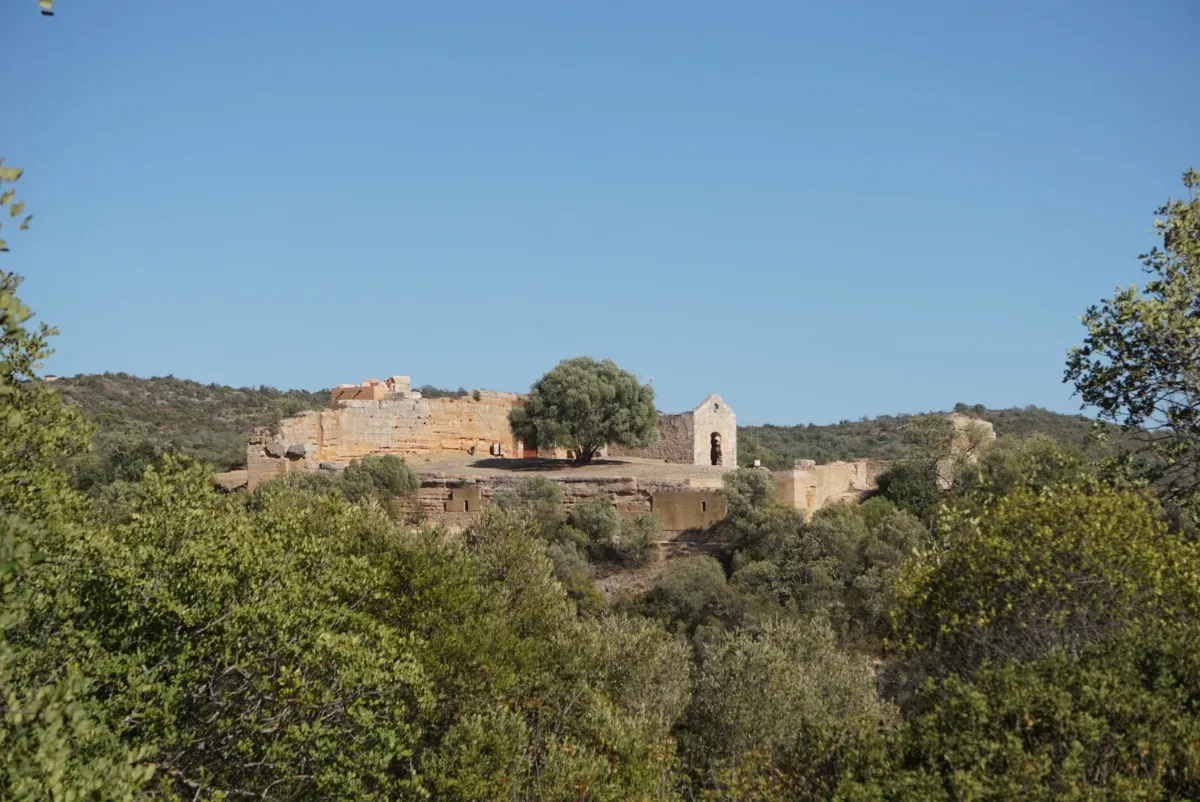
Nobody comes across Paderne Castle by accident. This medieval castle in the Algarve stands on a bare hill above a bend in the Quarteira river, twelve kilometres inland from the beach umbrellas of Albufeira, and the last stretch of the approach is a dirt track through fig and carob trees. What waits at the top isn’t a picture-postcard castle with turrets and flags: it’s an eight-hundred-year-old fortress built out of packed earth, half melted back into the hillside, and one of the seven castles you’ll find on the Portuguese flag.
What is Paderne Castle? An Almohad earth fortress in the Algarve
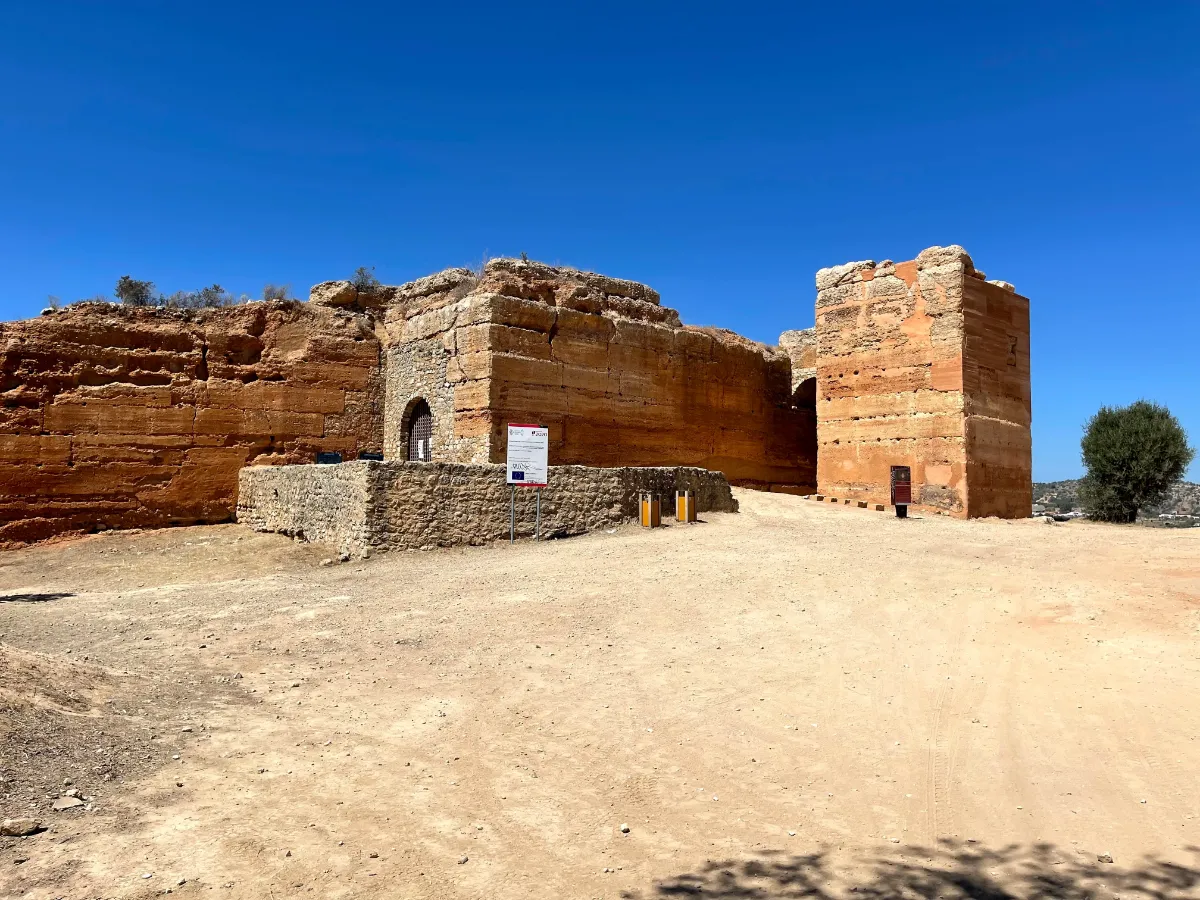
The first thing that surprises visitors is what the walls are made of. Paderne is not a castle of cut stone: it was raised in taipa, a rammed mixture of mud, lime, chalk and gravel poured between wooden shutters and left to harden like concrete. It sounds fragile. It isn’t. Those earth walls are almost two metres thick, they sit on a solid stone plinth, and they have stood through eight centuries of Algarve sun, winter rain and at least one catastrophic earthquake.
The fortress belongs to the last chapter of Islamic rule in the Algarve. With Christian armies pressing down from the north, the Almohads stopped relying on big walled cities alone and built a second line of medium-sized rural strongholds across the countryside. Paderne, sitting between Silves and Loulé, guarded a route linking the interior with the coast. Behind the wall wasn’t a garrison barracks but a small fortified farming settlement: narrow lanes, houses with central courtyards, cisterns, and a drainage system that carried waste and rainwater out beyond the walls.
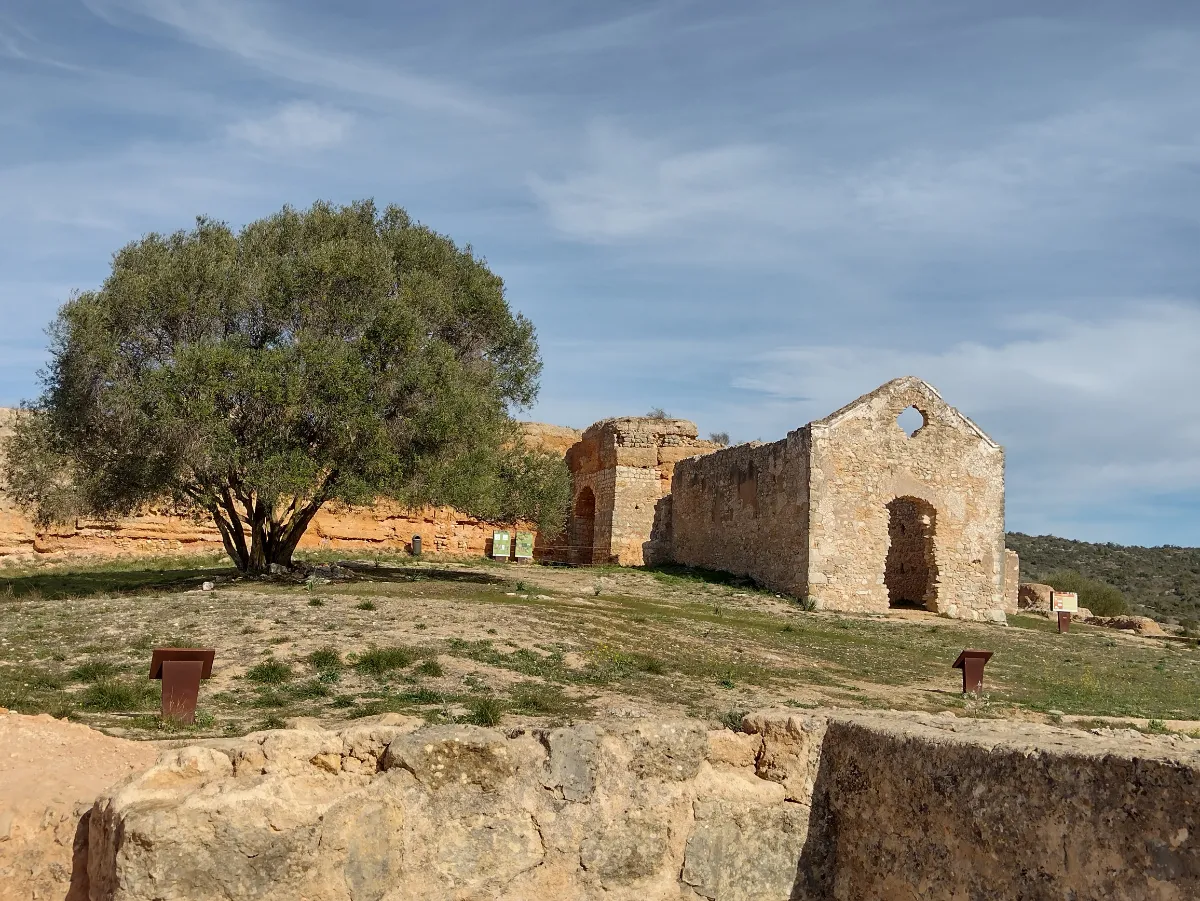
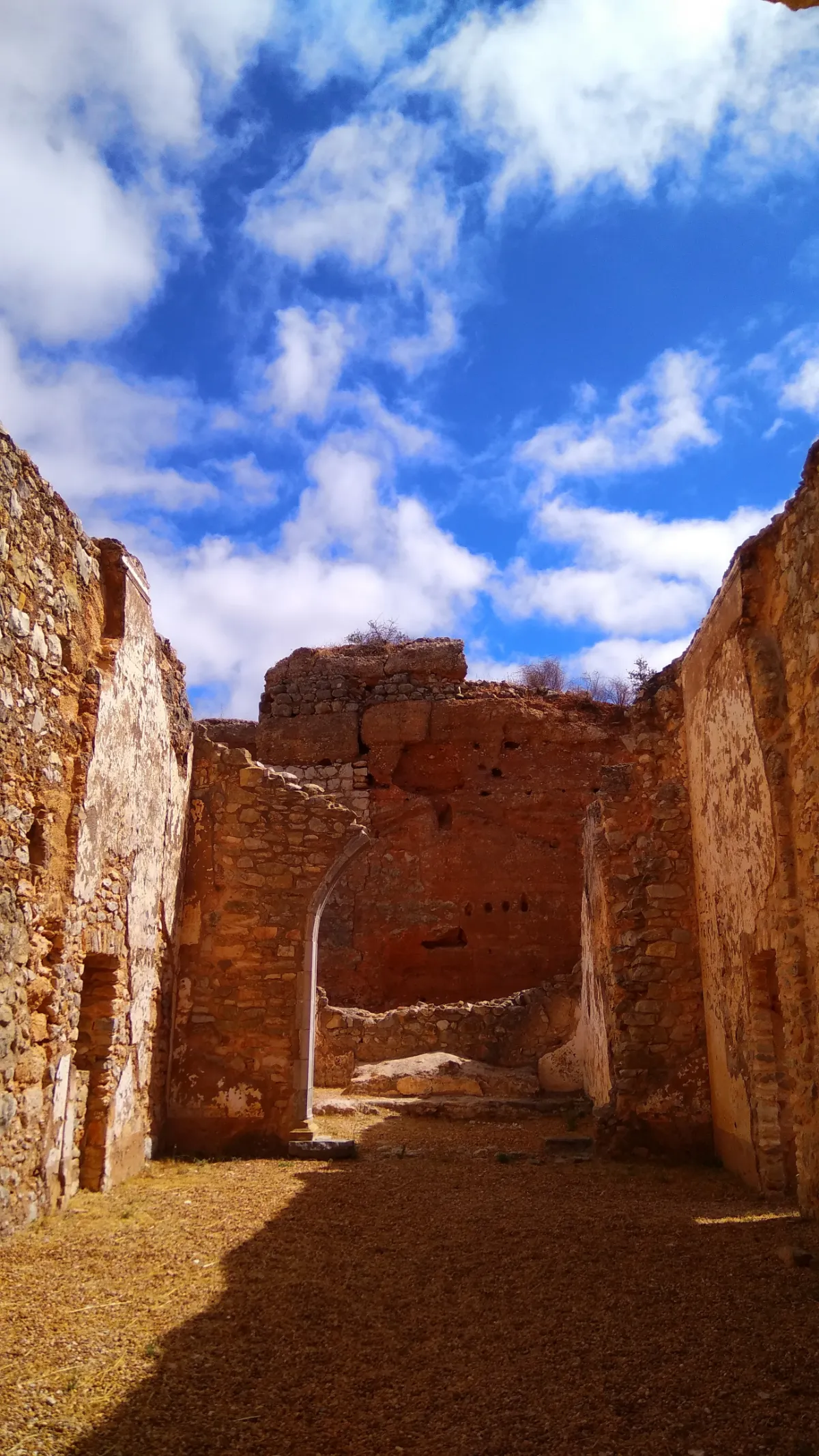
Today the enclosure is a trapezoid of roughly one hectare, open to the sky, with the ruins of a chapel along the south wall and a single surviving tower guarding the gate. The valley below is Natura 2000 land, thick with olive groves, carobs and Mediterranean scrub, and a footpath winds up to the walls from the old Roman bridge across the river.
The history of Paderne Castle in eleven key dates
Romans, Berbers, crusaders, warrior monks and, finally, archaeologists. Few hills in the Algarve have changed hands as often as this one, and the history of Paderne Castle reads like a summary of southern Portugal itself.
Rome takes the hill
The Romans occupy an existing Lusitanian hillfort and turn it into a military post, later an administrative centre called Paderna. The reason is the road below: the Via Lusitanorum crossed the Quarteira river right here.
The Moors arrive
The Roman estate falls to Muslim forces during the conquest of the peninsula. For the next five centuries the hill sits inside al-Andalus, and the surrounding countryside is farmed rather than fortified.
The Almohads build the castle
Christian raids empty the Muslim countryside, so the Almohads launch a building programme across the Algarve — Paderne, Silves, Loulé, Faro. The rammed-earth fortress you see today goes up, a refuge for the farming families of the Barrocal hills.
Sancho I and the crusaders
After the siege of Silves, carried out with the help of northern crusaders on their way to the Holy Land, Paderne surrenders to King Sancho I. The Portuguese flag flies over the hill for the first time.
Won back in two years
Caliph Abu Yusuf Ya’qub al-Mansur sweeps back through the Algarve and retakes the castle and its lands. The victory lasts a little over half a century.
The last siege
Dom Paio Peres Correia and the knights of the Order of Santiago take Paderne for the Portuguese crown under Afonso III. It is a brutal end: the Muslim inhabitants inside the walls are killed. A chapel is raised soon afterwards, almost certainly on the ruins of the mosque.
Handed to the warrior monks
After a round of repairs, King Dinis gives the castle to Dom Lourenço Anes, Master of the Order of Avis, hoping to turn it into a working military and economic centre. The plan never really takes.
The parish moves out
The chapel of Nossa Senhora do Castelo had served as the parish church for the valley. When a new church is built down in the village of Paderne, the congregation walks down the hill and doesn’t come back.
The earthquake
The great earthquake that flattened Lisbon shakes the Algarve hard. Already weakened by centuries of neglect, the walls of Paderne are badly damaged — much of what is missing today went that morning.
Abandoned for good
Isolated and ruined, the castle is formally abandoned and its hermitage, dedicated to Nossa Senhora da Assunção, is deconsecrated. For 140 years the hill belongs to goats, wild flowers and the wind.
Rescued by the archaeologists
The state heritage institute buys the monument and its land, surveys it in 3D and opens a recovery programme for the taipa walls and the chapel ruins. The digs uncover houses, streets, water channels, cisterns and a sewage system — the outline of a whole medieval village.
Five curiosities about Paderne Castle worth looking for
Paderne rewards visitors who know where to look. Most of the best stories about this Algarve castle are hiding in plain sight, in details a casual walk straight past the gate will miss.

It’s on the Portuguese flag
Look at the shield in the centre of Portugal’s flag and count the little yellow castles around the border: there are seven. They stand for the strongholds taken from the Moors during the Reconquest, and Paderne is identified as one of them. It’s an odd thought on a quiet hillside where you may well be the only visitor — this ruin is on every Portuguese passport, every football shirt, every government building in the country.
Mud walls pretending to be stone
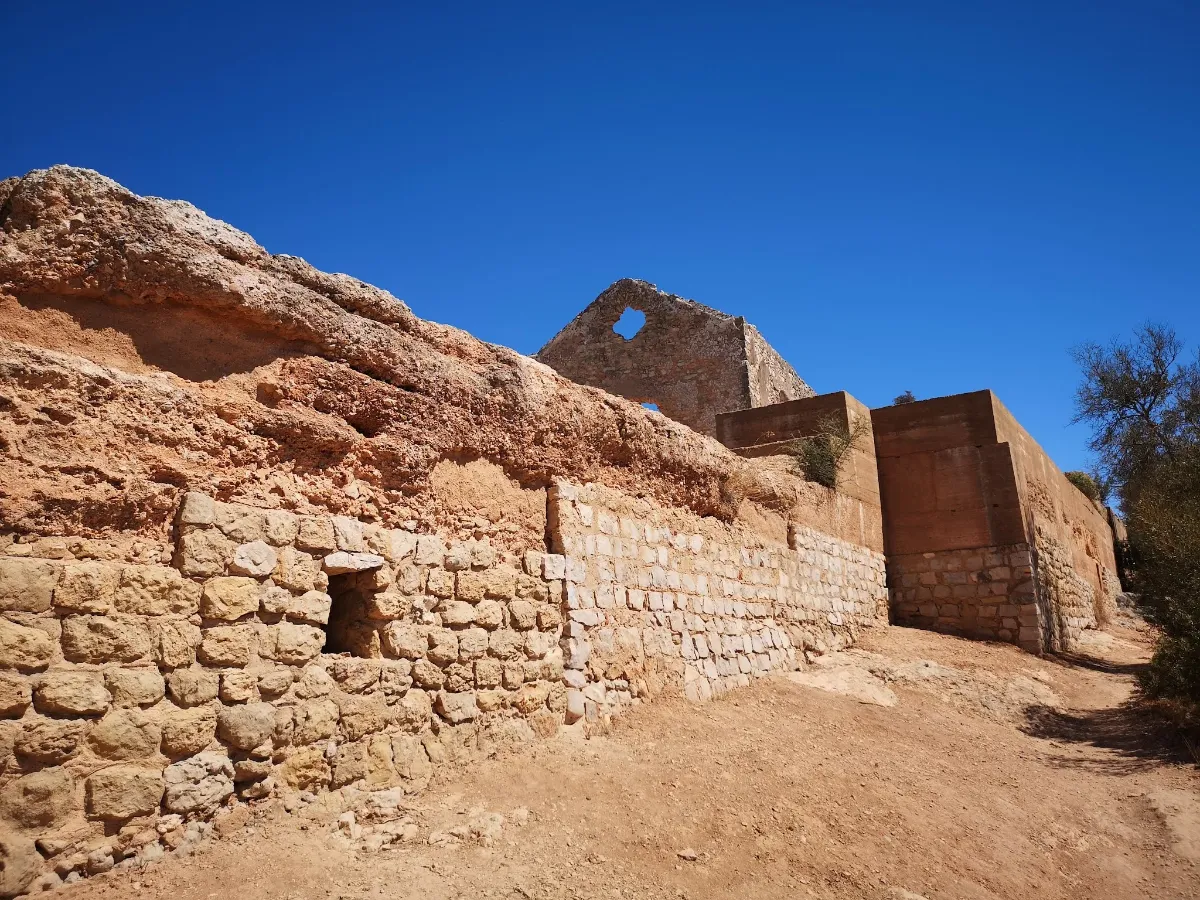
The surviving tower is the best place in Portugal to see Muslim military taipa up close. Get near the outer face and you can still make out pale whitewashed lines painted across the earth — fake joints, drawn on deliberately so that anyone approaching would think the tower was built of dressed masonry.
It was propaganda in lime: cheap, fast, and convincing from a distance. Behind the paint, the walls run 1.8 metres thick, with vertical slots left at intervals so rainwater could drain out instead of soaking the earth from within.
A gate you can’t charge at
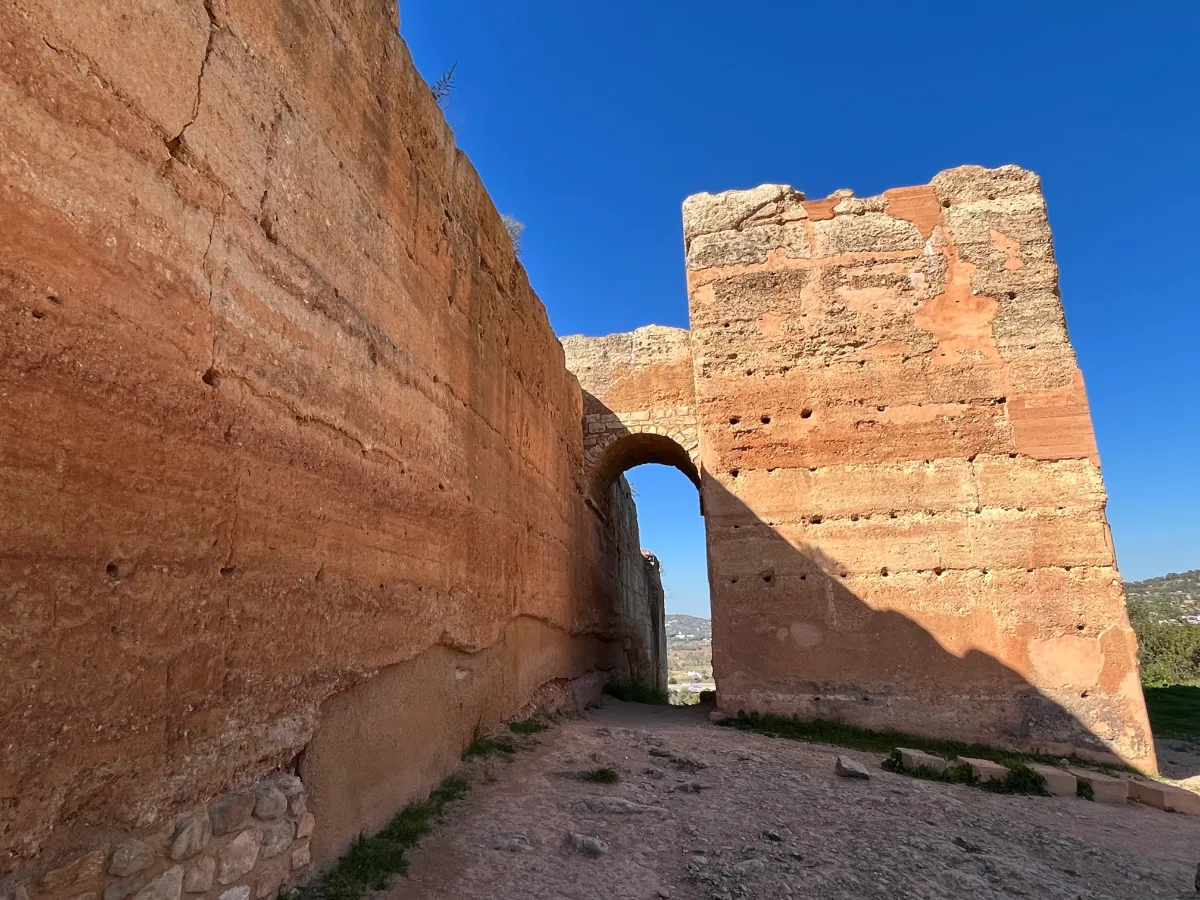
The entrance doesn’t face outwards. It turns a right angle against the main wall, forcing anyone attacking to slow down, break formation and expose their flank to the tower above before they reach the door. Walk in through it today and you’re following a route designed to make you an easy target — a classic bent-entrance gate, and the reason the eastern side, the one with the least natural protection, was also the best defended.
Two cisterns, two civilisations
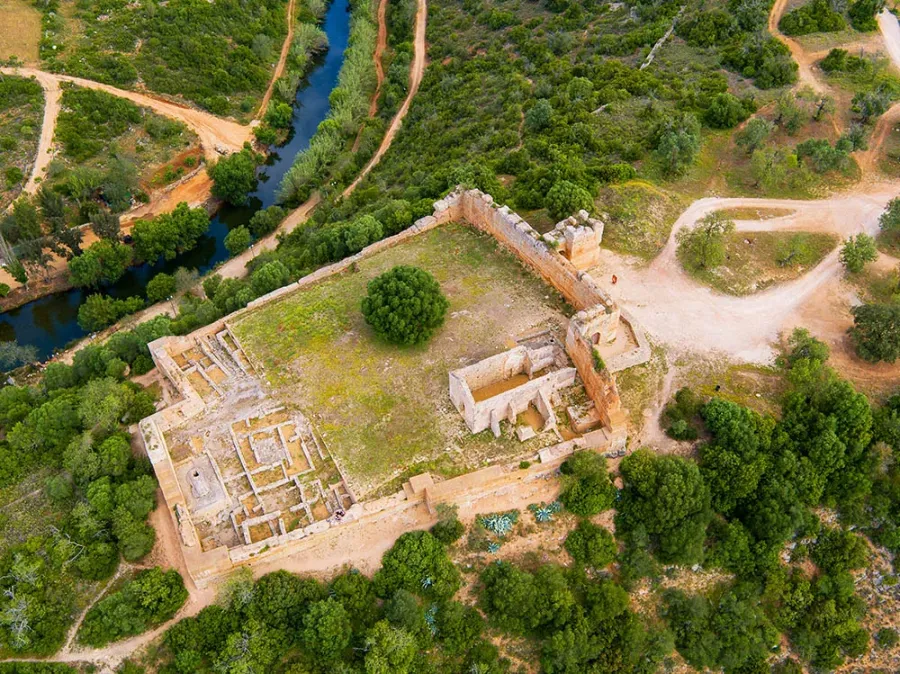
Inside the walls, among the low outlines of houses, sit two cisterns — one from the Islamic settlement, one from the Christian village that replaced it. They’re the clearest evidence of how the hill was reused rather than rebuilt: the new occupants moved into the old street plan and adapted it.
The excavations also turned up channels, a water supply network and a working sewage system, which is to say that a farming hamlet up here had better drainage in the 12th century than plenty of European towns managed six hundred years later.
The old bridge and the valley path
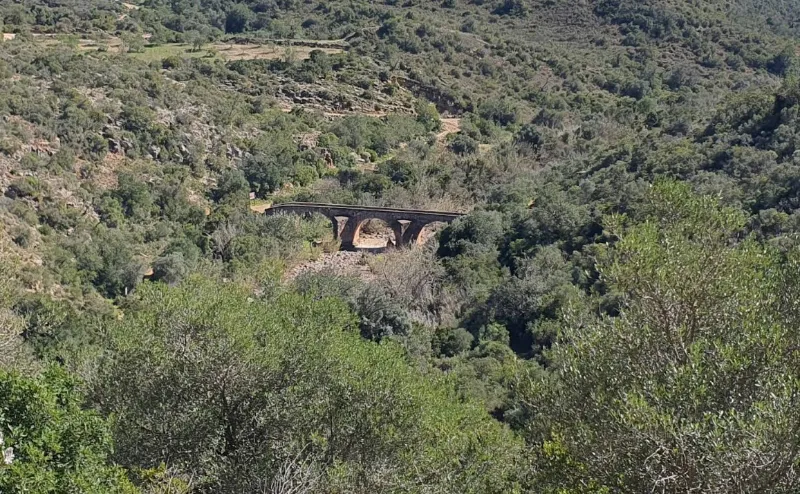
Below the castle, an arched bridge — long known locally as the Roman bridge — crosses the Quarteira river on the line of the ancient road the fortress was built to watch. A signed footpath links it to the walls through olive groves, figs and carob trees, all of it inside a Natura 2000 conservation area.
Come in the late afternoon and the whole valley turns the colour of the walls. It’s the single best photograph in the Albufeira hinterland, and there’s no ticket office in sight.
Visiting Paderne Castle: how to get there from Albufeira
Paderne Castle is an open-air monument, free to walk around and easy to fit into a morning out of Albufeira. Everything you need before setting off, in four cards.
Getting there
- 12 km north of Albufeira, near the village of Paderne.
- Address: Cerro do Castelo, 8200 Paderne.
- The final approach is an unpaved track.
- Also reachable on foot from the old bridge in the valley.
What to see
- The taipa tower and its painted fake joints.
- The bent L-shaped entrance gate.
- Ruins of the Chapel of Nossa Senhora do Castelo.
- The two cisterns and the outlines of the medieval houses.
- Views over the Quarteira valley.
Worth knowing
- No café, no shop and very little shade on the hill.
- Uneven ground and loose stones: wear closed shoes.
- Midsummer afternoons get very hot up here.
- Keep well back from the wall edges and crumbling taipa.
Good to know
- Access: open-air ruins, free to walk around.
- Guided tours: available by appointment.
- Best light: early morning or late afternoon.
- Nearby: Paderne village, Alte and Benafim.
Explore Albufeira and Paderne Castle by quad
Dirt tracks, hill villages and the castle on its ridge — the inland Algarve is best reached the way the old roads were meant to be travelled.
Explore Albufeira on quad